
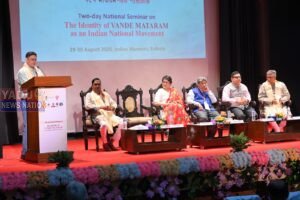
Kolkata, YNN: Sahitya Akademi, in collaboration with the Indian Museum, Kolkata; Eastern Zonal Cultural Centre (EZCC), Kolkata; The Sanskrit College and University, Kolkata; Santiniketan Sahityapath, Kolkata; and Akhil Bharatiya Sahitya Parishad, organised a two-day National Seminar on the occasion of the 150th anniversary celebrations of ‘Vande Mataram’. The seminar explored the identity and continuing significance of ‘Vande Mataram’ as an Indian national movement.
In the inaugural session, Varun Gulati, Secretary, Sahitya Akademi’s opening remarks situated the seminar within the 150th anniversary of ‘Vande Mataram’ and introduced its central inquiry into the song’s identity as an Indian national movement. The address established the academic and cultural framework of the gathering, bringing together literary voices, scholars, institutions and regional representatives. He highlighted how Bankim Chandra Chatterjee’s 1875 poem evolved from a literary work into the definitive, unifying anthem of India’s independence struggle. He reaffirmed the song’s role as historical glue that brought diverse factions together under a singular patriotic identity during the freedom movement and highlighted the song as a foundational binding force of Indian literature, heritage and collective consciousness. Nandini Sahu, from the Chief Guest address formed an important part of the inaugural proceedings devoted to ‘Vande Mataram’. In the context of the seminar, the address connected the commemorative occasion with the broader national movement and the historical-cultural resonance of Bankim Chandra Chattopadhyay’s composition, providing a wider public dimension to the discussions. Sayan Bhattacharya, Director, Indian Museum from the Guest of Honour highlighted the importance of preserving and interpreting India’s cultural heritage while reflecting on Vande Mataram’s historical journey. He emphasised the Indian Museum’s role in connecting literature, history and public memory, and welcomed scholarly dialogue that deepens understanding of the song’s national and cultural significance today. He also emphasized that the national initiative Ek Bharat Shreshtha Bharat directly mirrors the historical and cultural philosophy of Vande Mataram, acting as its modern, structural extension. Ashis Giri, Director, Eastern Zonal Cultural Centre also from the Guest of Honour emphasised the role of cultural institutions in bringing India’s diverse traditions into meaningful dialogue. He noted the significance of Vande Mataram as a subject of literary and historical reflection and welcomed the seminar’s regional participation, which enriched its broader national cultural perspective. Vande Mataram embodies the profound nationalism that Bengalis are deeply proud of, serving as a timeless cultural heritage that unites us all as we work together to restore and celebrate the historical glory of our nation. Madhav Kaushik, President, Sahitya Akademi in his Presidential Address underlined the importance of examining ‘Vande Mataram’ through literary, historical and cultural perspectives. The President’s intervention gave the seminar its principal institutional direction, emphasising sustained scholarly engagement with a text that has occupied an important place in India’s cultural memory and national consciousness. He emphasized that Vande Mataram is a timeless masterpiece that transcends poetry to paint a vivid picture of our nation. Translated into all Indian languages, its profound depth unfolds the more it is read and understood. Now deeply woven into our cultural DNA, this historic anthem must always be cherished and remembered in our hearts as a symbol of unity. Sudip Basu, from Santiniketan Sahityapath proposed the vote of thanks of the programme. The inaugural programme also included an Odissi dance presentation on ‘Vande Mataram’ by Shinjan Nrityalaya, Kolkata, adding a classical performing-arts dimension to the proceedings.
The first three sessions were chaired respectively by Varun Gulati, Neelam Rathi and Narayan Nayak. Participants: Hitesh Shankar; Pawan Putra Badal; Akhilesh Kr. Sharma (Mizoram); Bina Debbarma (Tripura); Chukey Bhutia (Sikkim); Dinesh Kumar Choubey (Meghalaya); Soma Bandyopadhyay (West Bengal); Taro Sindik (Arunachal Pradesh) examined Vande Mataram through literary, historical and regional perspectives, bringing diverse voices together to consider its place in India’s national movement and cultural consciousness.
The fourth and fifth sessions were chaired by Sadhana Balwate and Shashank Sharma. Participants: Prabhat Kumar Karan (Jharkhand); Prem Shanker Tripathi (West Bengal); Sanjay Kumar Singh ‘Sagar’ (Bihar); Akhilesh Kumar Shankhdhar (Manipur); Pranati Talukdar (Assam); Sonam Wangmu (Arunachal Pradesh); Sourav Kumar Mahanta (Odisha) presentations broadened the discussion geographically, reflecting on Vande Mataram through regional literary and cultural experiences and reinforcing the seminar’s national character.
The day concluded with a special theatrical presentation based on Bankim Chandra Chattopadhyay’s Anandamath by Purba Paschim, Kolkata, Purbashree, EZCC, Kolkata.

